
Identification
What a Flock camera looks like
A field guide to recognizing automated license plate readers: Flock Safety's Falcon on its slim pole and solar panel, Motorola and Vigilant fixed units, Genetec AutoVu, and Leonardo ELSAG hardware.
Published August 8, 2026
The standard installation
Flock Safety’s Falcon, sold since 2017 as the company’s standard roadway camera 2, is the model that has come to define what an automated license plate reader, or ALPR, looks like in the United States. The installation follows a template so consistent that it can be recognized at a glance: a small black camera unit mounted near the top of a slim, dedicated pole, with a compact solar panel tilted toward the sky above it 5. The camera runs on that solar power and sends its data over an LTE cellular connection, so it needs no trenching, no wiring, and no tie-in to existing utilities — Flock advertises that a unit can be installed and capturing searchable data within hours 1.
That self-sufficiency shapes where the cameras appear. Because the pole ships with the product, a Falcon does not need to borrow a streetlight or a signal mast; it can stand alone on a grass median, a roadside shoulder, or the mouth of a subdivision. ALPRs as a category are typically mounted on street poles, streetlights, and highway overpasses, or carried on mobile trailers and patrol cars 4. Flock’s own marketing points its shorter-range models at inner-city spaces, business and school parking lots, and park entrances 2, and its residential camera at the entrances and exits of neighborhoods 3.
Whatever the mounting, the function is the same. An ALPR automatically photographs every license plate that comes into its view and records the plate number together with the location, date, and time; the photographs often capture the vehicle itself, and sometimes its driver and passengers 4. Systems of this class can collect thousands of plates per minute 4.
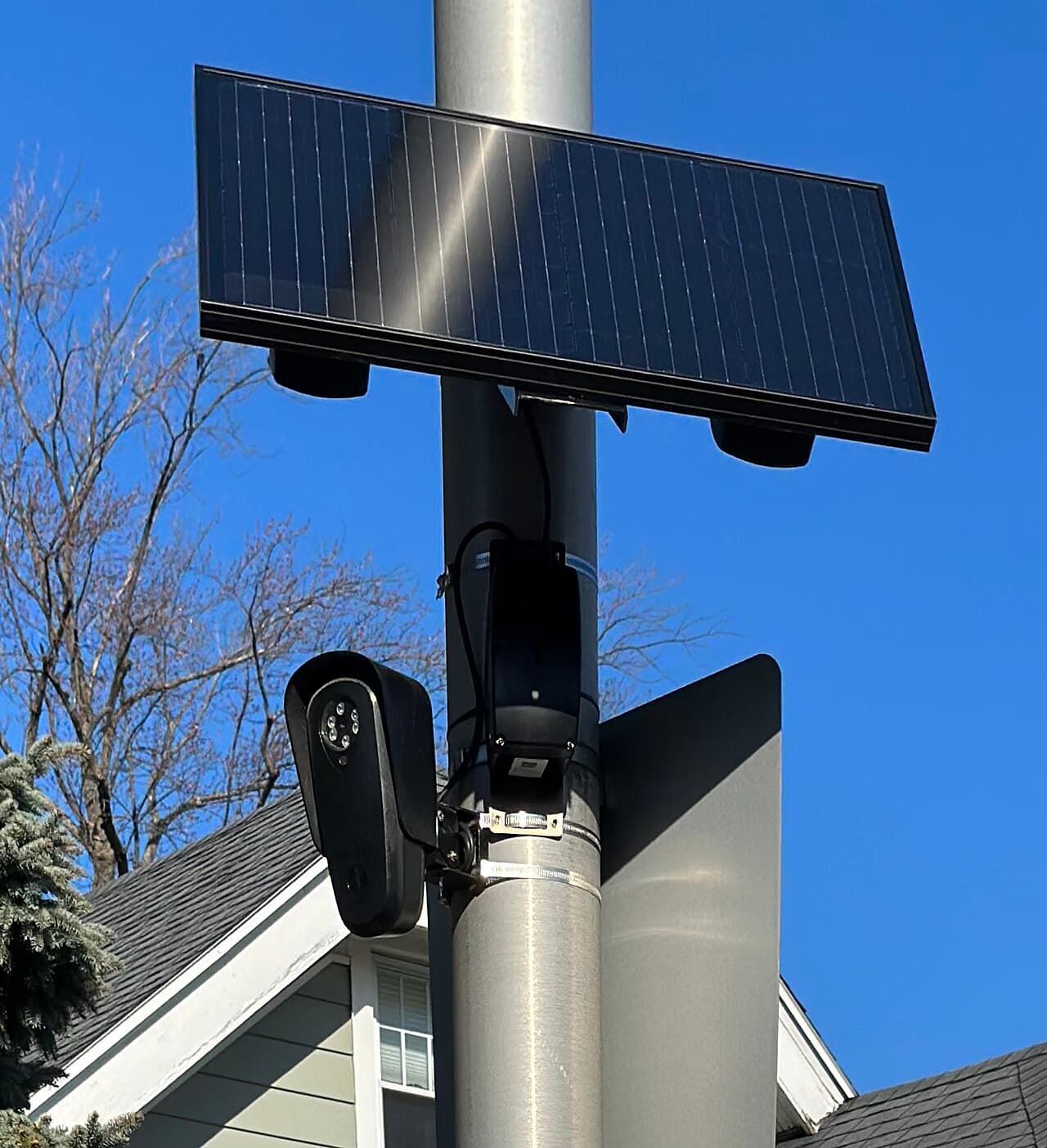
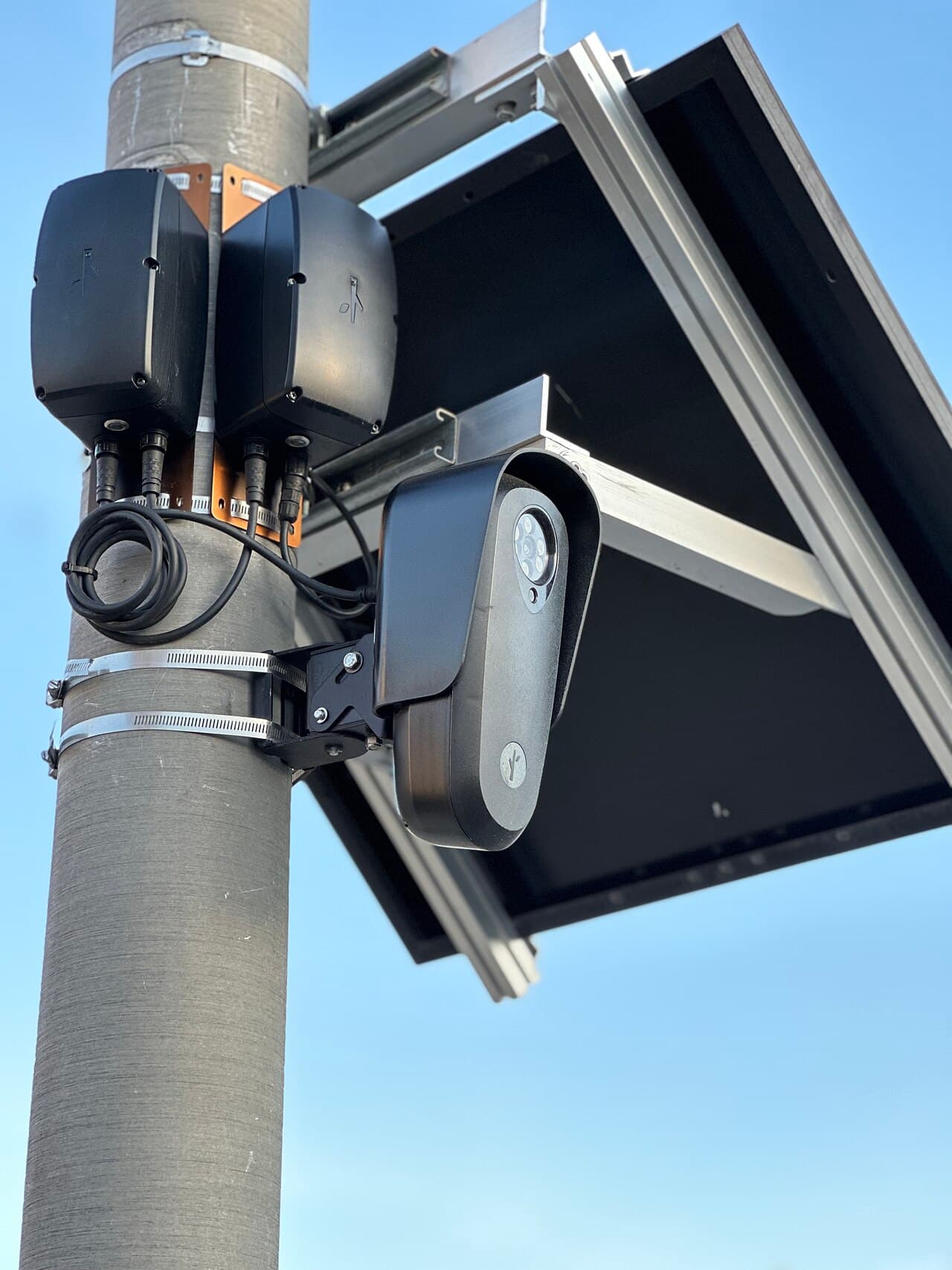
Flock's product line
Flock names its plate-reading cameras after birds, and the Falcon family covers most road types. The standard Falcon is the general-purpose roadway unit the company has sold since 2017 2. The Falcon SR — for short range — is a tactical variant designed to capture tighter angles and distances; Flock lists inner-city spaces, business or school parking lots, and park entrances as its intended settings 2. The Falcon LR, for long range, is built for high-speed, high-volume roadways such as interstate highways 2. The Falcon Flex, introduced in 2021, is a location-flexible version meant to be moved between sites 2. Flock’s current product page organizes the same line by function — a standard camera for two-lane roads, a long-range camera for multi-lane traffic, and a lightweight relocatable model — and adds an LPR trailer for temporary coverage of events or hot spots, with no construction needed 1.
The Sparrow rounds out the plate-reading line. Marketed to homeowners associations and residential communities, it is described by Flock as sleek, low-profile, and completely infrastructure-free, running entirely on solar power and aimed at recording vehicles entering and exiting a neighborhood 3.
Not every device on a Flock pole reads plates. The company also sells the Condor, a video camera line whose pan-tilt-zoom variant is aimed at intersections and open areas and whose fixed bullet variant is pitched at buildings and city streets, along with the Raven, an audio sensor for gunshot detection 2. A Flock installation may therefore carry hardware that is not a license plate reader at all — one reason careful identification matters.
Motorola Solutions and Vigilant
Motorola Solutions is the other large American ALPR vendor. Its cameras feed the VehicleManager analytics platform 7, and the Electronic Frontier Foundation’s identification guide lists the vendor as “Motorola Solutions (formerly Vigilant Solutions)” 5.
Motorola’s fixed systems are marketed as a “virtual fence”: permanently installed readers capturing data on high-speed, high-volume roadways 6. Rather than the all-in-one pole-and-panel package that defines a Flock installation, stationary readers of this kind are typically attached to existing infrastructure — utility poles, highway overpasses, or dedicated poles with their own solar panels 5. The company also sells a dual-purpose unit that produces multi-lane plate data and conventional color security video from a single camera 6.
The L6Q, Motorola’s quick-deploy model, is a compact, self-contained unit designed for temporary or semi-permanent installation almost anywhere 7. It carries long-range integrated infrared illumination and a low-light “starlight” sensor so it can read plates in complete darkness, and it runs on solar power, AC/DC, or a swappable internal high-capacity battery 7. For mobile use, Motorola sells camera systems that ride on patrol vehicles or trailers, providing 360-degree plate coverage as the vehicle moves 6.
Genetec AutoVu SharpV
Genetec’s AutoVu SharpV presents a different silhouette. Instead of a camera head under a separate solar panel, the SharpV is a single rectangular housing — roughly 21 centimeters (8.5 inches) long and 19 centimeters (7.6 inches) wide 9, finished in white or black 8 — that mounts to a pole or wall with brackets included in the box 9. Behind its front glass sit two lenses side by side: a monochrome global-shutter sensor that reads plates, and a color “context” camera that records an overview image of each vehicle 8.
The SharpV carries built-in pulsed-LED illuminators — offered in 940, 850, 740, and 590 nanometer wavelengths — for capture in total darkness 8. It is powered over Ethernet or by a 24-volt supply rather than by sunlight 8, which is why SharpV installations tend to sit where wired infrastructure already exists. Genetec markets the camera both for scanning vehicles on busy roadways, from slow local streets to fast multi-lane highways, and for keeping track of vehicles accessing facilities 8.
Leonardo ELSAG
The ELSAG Fixed Plate Hunter, sold in the United States by Leonardo, uses fixed cameras attached to existing infrastructure such as a utility pole or sign gantry 11. An installation pairs two kinds of imager: an infrared camera that captures black-and-white images of each plate, and a color camera that captures an overview image of each vehicle 11. The company states the system reads plates day or night, in any weather, at passing speeds of up to 150 miles per hour from over 100 feet away 11.
Leonardo markets fixed deployments along key arteries and highways and on bridges, tunnels, and overpasses, where a single system can capture vehicles across multiple lanes 10. For sites without power, the company sells the Street Sentry, a pole-mounted, autonomous unit that carries its own solar-and-battery supply 10 — a configuration that, from the roadside, can resemble the dedicated-pole installations described above.
How to confirm what you're seeing
None of these vendors publishes a public map of its installations, so confirming a sighting means checking independent records. The Finding Flock map plots every ALPR in the United States that OpenStreetMap contributors have reported. If a reader has already been documented on your street, its entry carries whatever details volunteers recorded — often the manufacturer, the mount, and the compass direction the camera faces — and links to the underlying OpenStreetMap record, including its full edit history; our methodology page explains how that pipeline works.
The manufacturer mix in that dataset matches what this guide would lead you to expect: about 80.4 percent of the cameras documented on this site are recorded as Flock-made, with the remainder split among the other vendors profiled here — the manufacturer index breaks that mix down by vendor, state, and city, and the methodology page explains how manufacturer data is captured and where it falls short. Two caveats apply. Documentation lags installation: a camera appears on the map only after a volunteer records it, so absence from the map is not evidence that a road is unwatched. And identification from hardware alone has limits: several vendors sell similar-looking compact solar units, and a pole-mounted camera may turn out to be a traffic sensor or an ordinary security camera rather than a plate reader.
This guide covers what the hardware looks like. For what the cameras do with what they capture — the “vehicle fingerprint,” the shared lookup networks, the retention windows — see What is a Flock camera? For the rules that govern their use, which vary sharply from state to state, see our state-by-state guide to ALPR laws.
Sources
- License Plate Readers (LPR) Cameras — Flock Safety
- Flock Safety Product Announcement Q2 2023 — Flock Safety, May 2023
- The Best Tips and Technology to Keep Your Neighborhood Crime-Free — Flock Safety
- Automated License Plate Readers (ALPRs) — Electronic Frontier Foundation, Street-Level Surveillance
- How to Identify Automated License Plate Readers at the U.S.-Mexico Border — Electronic Frontier Foundation, November 2025
- License Plate Recognition Camera Systems — Motorola Solutions
- L6Q Quick-Deploy License Plate Reader Camera — Motorola Solutions
- AutoVu SharpV Product Specifications — Genetec, November 2021
- Specifications for the SharpV, AutoVu SharpV Administrator Guide — Genetec
- ELSAG Fixed License Plate Readers — Leonardo
- Leonardo's ELSAG Fixed Plate Hunter License Plate Readers — SourceSecurity.com, 2021